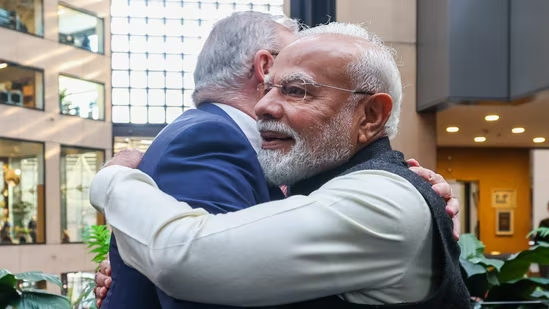



















A historic uranium deal, plans to boost LNG imports and a stronger defence partnership are among the key outcomes expected from Prime Minister Narendra Modi’s visit to Australia, according to sources.
The Prime Minister and his Australian counterpart, Anthony Albanese, are expected to discuss a broad agenda, ranging from energy security and critical minerals to defence cooperation, maritime security, and technology partnerships, during the three-day visit.
The visit comes at a time when both countries are looking to deepen cooperation amid shifting geopolitical dynamics in the Indo-Pacific region.
‘Historic’ uranium pact, LNG in focus
A “historic Uranium agreement to secure Uranium supplies for India’s civil nuclear energy” is expected to be among the major highlights of the visit, sources said. The deal would strengthen India’s energy security as it looks to expand its nuclear power capacity.
The deal holds significance as Australia currently has the world’s largest known uranium reserves, accounting for nearly 28 per cent of global resources, making it a crucial partner of New Delhi.
Energy security is also expected to feature prominently in the talks. Sources said both countries are likely to strengthen their energy partnership, with India expected to “increase imports of liquefied natural gas (LNG), coal and diesel” as part of its broader diversification strategy.
The proposed measures are expected to help India secure reliable energy supplies while reducing the risks associated with overdependence on any single source. The need for such diversification gained renewed urgency during the US-Iran conflict, when disruptions in the Strait of Hormuz highlighted India’s vulnerability to supply-chain shocks in West Asia.
Major boost to defence ties
Defence and security cooperation are also set to make up a major part of the talks. According to the source familiar with the discussions, both sides are working towards “a joint defence declaration” that could pave the way for “a defence industrial corridor and enhance interoperability between the armed forces” of the two countries.
Officials familiar with the agenda said India and Australia are expected to create a defence innovation corridor focused on startups, defence manufacturing and emerging technologies.
In another significant step, India is expected to deploy Army officers at the Australian Defence College, a move aimed at strengthening professional military exchanges between the two armed forces.
India-Australia PACTS and others
Another expected outcome is the proposed Australia-India PACTS agreement, which, according to sources, would focus on “cyber cooperation, critical technologies and supply chain resilience.”
The two countries are also expected to strengthen cooperation in the critical minerals sector.
Sources said India and Australia are also looking to collaborate on creating a critical mineral corridor to facilitate investment, processing and supply chain partnerships. Such an arrangement could help India secure access to minerals essential for batteries, renewable energy infrastructure and advanced manufacturing.
Both countries are likely to “ramp up partnership in Indo-Pacific” through a maritime security roadmap focused on maritime domain awareness and coastal surveillance, the source added.
Counter-terrorism is expected to remain another major area of engagement. Officials said there will be a “strong emphasis on counter terrorism” as both nations seek closer coordination on regional and global security issues.
After concluding his engagements in Australia, Narendra Modi will travel to New Zealand, the final stop of his three-nation tour.



