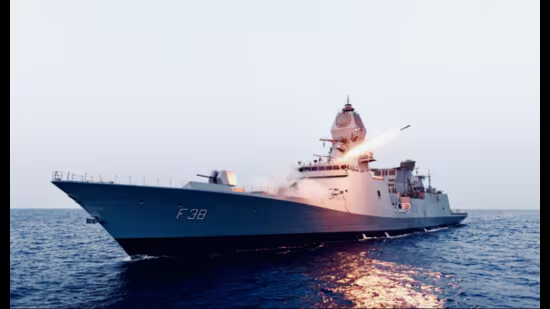






















The Indian Navy will commission its latest stealth frigate, Mahendragiri, in Visakhapatnam on July 11, a step towards boosting its presence in the Indian Ocean region and the larger Indo-Pacific, amid China’s push in the vast maritime expanse.
“As India continues to strengthen its role as the preferred security partner in the Indian Ocean region, Mahendragiri will serve as a formidable force multiplier, safeguarding the nation’s maritime interests and contributing to a secure, stable and prosperous Indo-Pacific,” the Navy said on Monday.
The sixth of seven stealth frigates under the ₹45,000-crore Project 17A, the warship is named after the Mahendragiri mountain range in the Eastern Ghats. This follows the commissioning of three indigenous vessels—a stealth frigate, an anti-submarine warfare craft and a survey ship—on June 21.
India has consistently called for a free, open and inclusive order in the Indo-Pacific, pivoting on respect for the sovereignty and territorial integrity of all nations, while stressing peaceful resolution of disputes through dialogue and under the framework of international laws.
Project 17A exemplifies India’s growing expertise in indigenous warship design and construction, the navy said.
“The commissioning of Mahendragiri marks another significant milestone in the successful execution of the P-17A. As successive frigates of the class join the fleet, they continue to strengthen the Indian Navy’s combat capability while reinforcing India’s position as a leading indigenous warship-building nation,” it said in a statement.
The final P-17A frigate, Vindhyagiri, will be commissioned later this year. Nilgiri, Udaygiri, Taragiri and Mahendragiri were built at Mumbai-based Mazagon Dock Shipbuilders Limited (MDL). Himgiri and Dunagiri were constructed at Kolkata’s Garden Reach Shipbuilders and Engineers Limited (GRSE), where Vindhyagiri is under construction.
The P-17A (or Nilgiri-class) platforms reflect India’s advanced warship-building capabilities, featuring 75% indigenous content and equipped with cutting-edge weapons, sensors and systems designed to dominate the maritime battlespace. The P-17A, a successor to the Shivalik-class stealth frigates (P-17), marks a significant leap forward in warship design and capability.
The frigates are equipped with modern weapons and sensors, including the BrahMos supersonic cruise missile, the Barak-8 surface-to-air missile system, MF-STAR surveillance radar, and anti-submarine warfare capabilities. The warships have a displacement of 6,670 tonnes, are 149 metres long, can reach a top speed of 28 knots, and carry 225 personnel.
“Incorporating advanced stealth features, enhanced survivability, reduced radar signature and a high degree of automation, the frigate is powered by a modern combined diesel or gas (CODOG) propulsion system, enabling high-speed operations with exceptional endurance across the full spectrum of maritime missions,” the Navy added.
The Navy is working towards becoming fully self-reliant by 2047, when India celebrates 100 years of independence. Around 60 warships are under construction at Indian shipyards.



