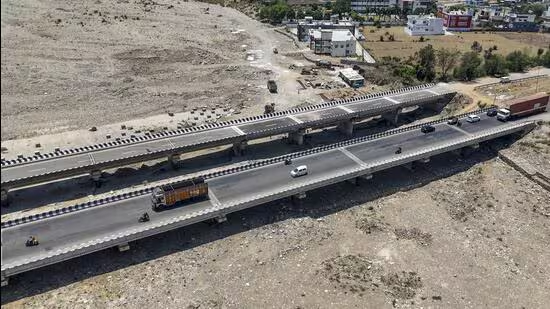























The Union road transport and highways ministry plans to centralise the software platform for real-time bridge health monitoring by engaging the Indian Institute of Technology Madras and Centre for Development of Advanced Computing (C-DAC), even as the supply, installation and maintenance of sensors will be awarded separately through competitive bidding under a new standardised tender model for all upcoming projects.
In a July 6 circular, the ministry said all bridge health monitoring system (BHMS) components in highway contracts, where physical work has not yet commenced, must be removed and re-tendered using the new Model Request for Proposal. The move is aimed at creating a uniform framework for deploying continuous real-time monitoring systems on bridges across the national highway network.
The circular said that executing agencies, including state public works departments for central government-funded projects, the National Highways Authority of India, National Highways and Infrastructure Development Corporation Ltd, Border Roads Organisation, and other agencies implementing centrally sponsored highway projects, will have to de-scope BHMS works from contracts wherever execution has not started, following the provisions of the respective contract or concession agreement.
For projects where BHMS installation has begun, implementing agencies may continue under the existing contractual arrangement. They must furnish details of such bridges, including the contractor or concessionaire and the BHMS service provider, to the ministry’s standards and research wing within 30 days. Failing this, the ministry said it would presume that the BHMS component has been de-scoped in accordance with the new directions.
Bengaluru’s Indian Institute of Science civil engineering professor JM Chandra Kishen said the analysis of data from bridge sensors is a very sophisticated exercise, as there is often a lot of white noise. He said the centralisation will help in achieving uniformity in how data are synthesised to help in better administration.
The ministry earlier directed all road-owning agencies, including state public works departments, to complete a nationwide digital inventory survey of bridges by September 30 under the Indian Bridge Management System for a database of bridges to support scientific monitoring, maintenance and timely interventions.
There have been multiple bridge collapses in recent years. The Morbi suspension bridge collapse in Gujarat in October 2022 left at least 141 people dead. In 2025, four people were killed in a bridge collapse near Pune. The Gambhira Bridge collapse in Gujarat in July 2025 claimed 22 lives.



