

























The Reserve Bank of India (RBI) has proposed linking the official digital currencies of BRICS nations to make cross-border trade and tourism payments smoother, reported news agency Reuters, citing two officials familiar with the matter.
According to the report, the Reserve Bank of India (RBI) has recommended that the government place the proposal on the agenda for the 2026 BRICS summit, which India will host later this year.
If accepted, it would mark the first formal attempt to link the central bank digital currencies (CBDCs) of BRICS members, a move that could reduce dependence on the US dollar at a time of heightened geopolitical tensions.
The BRICS grouping includes Brazil, Russia, India, China and South Africa, along with newer members such as the UAE, Iran and Indonesia.
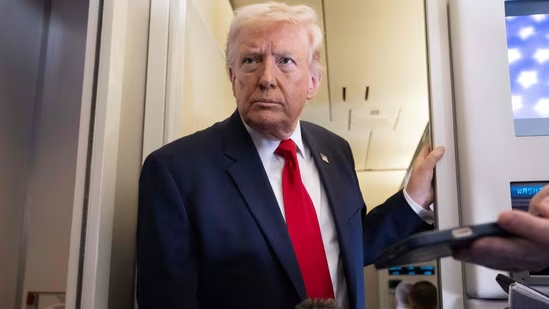
Any initiative to operationalise digital settlements among these nations is likely to draw scrutiny from Washington, especially as US President Donald Trump has previously labelled BRICS “anti-American” and threatened tariffs on member countries.
The RBI, the Indian government, and several BRICS central banks either declined to comment or said they had no information to share, the Reuters report added.
The proposal expands on a 2025 declaration at the BRICS summit in Rio de Janeiro, which encouraged interoperability between members’ payment systems to improve cross-border efficiency.
India has repeatedly spoken of its interest in linking the digital rupee with other nations’ CBDCs to speed up cross-border settlements and support greater use of the Indian currency globally.
Although none of the BRICS members have fully launched their CBDCs, all five core economies are running pilots. India’s e-rupee has gathered about seven million retail users since its introduction in December 2022, while China has been pushing for wider international use of its digital yuan.
The RBI has also enabled offline payments, programmability for government subsidies and fintech wallet integration to encourage adoption.
For BRICS currency linkages to work, a shared framework for technology, governance, and settlement of trade imbalances will be essential, one official told Reuters. Differences over which technology to use or which country’s platform to rely on could slow progress, making consensus critical.
One option being explored involves bilateral foreign exchange swap lines between central banks to settle transactions on a weekly or monthly basis. This may help avoid the kind of imbalance that emerged when Russia accumulated large amounts of rupees after India imported Russian goods but could not offer equivalent exports in return.
The broader BRICS project has regained attention amid Trump’s revived tariff threats and geopolitical realignments. India’s ties with Russia and China have strengthened economically even as New Delhi faces trade frictions with Washington.
However, the bloc’s effort to create a common BRICS currency has been shelved, and global enthusiasm for CBDCs has been tempered by the rapid spread of stablecoins.
Indian officials remain wary of stablecoins, which the RBI argues could undermine monetary stability and fragment the payments ecosystem. Deputy Governor T. Rabi Sankar recently said CBDCs offer a safer alternative because they avoid risks associated with privately issued digital tokens.
India’s proposal to link BRICS digital currencies now sets the stage for what could become one of the most consequential financial discussions at this year’s summit, potentially reshaping how emerging economies settle trade and challenge the dominance of the US dollar.



