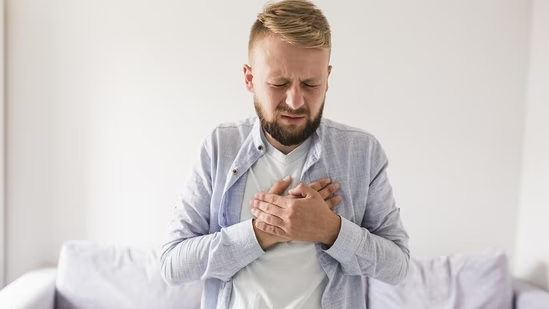






























Heart attacks don’t always announce themselves the way films would have you believe – with dramatic chest-clutching and sudden collapse. In reality, the warning signs can be far subtler and easier to dismiss, ranging from a dull ache in the jaw to unexplained arm pain, fatigue, or flu-like symptoms. Recognising these quieter signals – and seeking medical attention to rule out something serious – can be life-saving, especially when your body is trying to tell you something isn’t right.
Dr Evan Levine, a New York-based cardiovascular specialist with 30 years of experience, with board certifications in Internal Medicine, Cardiology, and Nuclear Cardiology, has highlighted that nearly 40 percent of heart attack patients – particularly women and older adults – experience atypical symptoms, emphasising the critical importance of paying close attention to your body’s warning signals.
In an Instagram video shared on January 28, the cardiologist recounts the story of an elderly woman whose arm pain was dismissed as a muscle strain: “She was sent home from the emergency room with a strained left arm. The family told the doctor she’d barely moved all day, but they didn’t listen; 30 minutes later, she was dead on her garage floor. Local police and EMS were standing over her body before her papers were even cold. We’ve been told to think of a heart attack as someone clutching their chest and collapsing. But if you’re waiting for chest pain, you might be waiting for your own funeral.”
Atypical heart attack symptoms
According to Dr Levine, nearly 40 per cent of heart attack patients do not experience the classic warning signs and instead present with atypical symptoms. He explains, “When your heart muscle is starving for oxygen, your nerves get confused. They send signals everywhere, and sometimes not to the chest. It’s the jaw that feels like a toothache. It’s the strain in that left arm when you haven’t lifted a finger. It’s the sudden flu or exhaustion that hits you like a freight train.”
Who is more likely to have atypical symptoms?
The cardiologist highlights that women and older adults – particularly those over the age of 70 – are more likely to experience atypical symptoms, making it crucial to ensure emergency room staff consider all reported symptoms to avoid the risk of misdiagnosis.
Circling back to the case of the elderly woman, Dr Levine notes, “Why did that grandmother die? Because in the elderly, pain perception changes. A heart attack can look like a fall or a fainting spell or sudden confusion or arm pain. And for women, you’re statistically more likely to be dismissed because you’re told it’s anxiety, reflux, or stress.”
Listen to your body
Dr Levine highlights the importance of listening to your body’s warning signals and cautions against brushing off sudden, unexplained pain, noting that it should be treated as a possible heart attack unless a cardiologist determines otherwise.
He emphasises, “If you have sudden pain anywhere in your body, from your belly button to your jaw, or if you’re sweating for no reason, and you have risk factors for having heart disease, well, it may be a heart attack until the cardiologist proves it isn’t.”
The cardiologist stresses that you should refuse to settle for a diagnosis that does not align with the story your body is telling. It is important to demand lab tests and screenings to find out the root cause of your pain.
He suggests, “Here’s the rule that saves lives: If the story doesn’t match the diagnosis, don’t leave. If they tell you your 85-year-old mother has a muscle strain, but she hasn’t been out of her chair, you demand a serial EKG. You demand a second set of troponin enzymes. You demand a consult. One EKG can be normal in the beginning and one blood test may not show that leak of troponin. Stop looking for chest pain, start looking for the truth. It’s your life or your mother’s life on the line.”



