


























The Supreme Court on Monday restrained the Gujarat government from taking any coercive measures against land and properties held by the ashram of self-styled godman Asaram Bapu in Ahmedabad, observing that the municipal authorities’ show-cause notice “prima facie lacked material particulars”.
A bench of justices Vikram Nath and Sandeep Mehta ordered maintenance of status quo, effectively putting on hold the April 17 judgment of the Gujarat high court that had cleared the way for the state to reclaim around 45,000 square metres of land occupied by the Sant Shri Asaram Ashram in Motera, near the Narendra Modi Stadium.
The land forms part of a larger 650-acre parcel earmarked for the proposed Sardar Patel Sports Enclave, including an Olympic Village and allied infrastructure tied to Ahmedabad’s bid for the 2036 Olympics and preparations for the 2030 Commonwealth Games.
The top court’s intervention came after it found apparent deficiencies in the very foundation of the state’s action — the show-cause notice issued to the ashram.
During the hearing, the bench repeatedly pressed the state to justify its case on the basis of the notice itself. “Ultimately, your case has to stand on your notice. Your notice prima facie lacks material particulars,” the court told solicitor general Tushar Mehta, appearing for the Gujarat government.
The bench also questioned the state’s shifting position over the years. Referring to past regularisations, it noted that portions of the land initially described as encroachments had been regularised by the authorities. “So, you were benevolent that you regularised land despite calling it an encroachment. What happened overnight that you want it cancelled?” asked the court.
The state argued that the ashram had exceeded its original allotment of 6,261 square metres made in 1980, encroaching upon additional land that was later regularised in phases. It also relied on findings recorded by the high court regarding unauthorised constructions and alleged non-compliance with land-use conditions.
The bench pointed out that such allegations must find place in the notice itself. “Where is all this mentioned in your notice?” it asked, underscoring that administrative action must be judged on the reasons disclosed to the affected party.
Senior advocate Mukul Rohatgi, appearing for the ashram, contended that the entire action was “illegal and mala fide”, alleging that the trust was being targeted because the land falls within the proposed sports development zone.
He argued that the ashram had valid sanction plans dating back to the 1980s and that eviction proceedings were initiated selectively, despite similar accommodations being extended to other entities.
The court granted the state three days to file its counter affidavit, with the petitioners given an equal window to respond.
The matter is now listed for May 5, with the bench directing that status quo be maintained in the interim.
The Supreme Court’s order pauses the operation of the Gujarat high court’s April 17 ruling, which had dismissed the ashram’s challenge to eviction notices issued by revenue authorities.
The high court had held that the trust violated conditions of land allotment and had encroached upon substantial areas, including portions of the Sabarmati riverbed. It rejected the plea for regularisation, observing that any such indulgence would run contrary to established legal principles governing public land.
The court also declined to stay its judgment, allowing the state to proceed with reclaiming the land for the proposed sports infrastructure project.
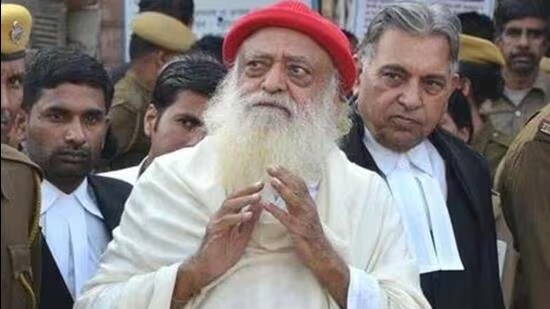
Asaram, who founded the ashram in 1972, is serving life imprisonment in multiple rape cases. In 2018, a court in Jodhpur convicted him for sexually assaulting a minor girl at his Rajasthan ashram, sentencing him to life imprisonment.
This was followed by another life sentence in 2023 by a Gandhinagar court in a separate case involving a woman disciple, who was subjected to repeated sexual assault between 2001 and 2006.
He is currently out on medical bail, even as the convictions continue to stand.



