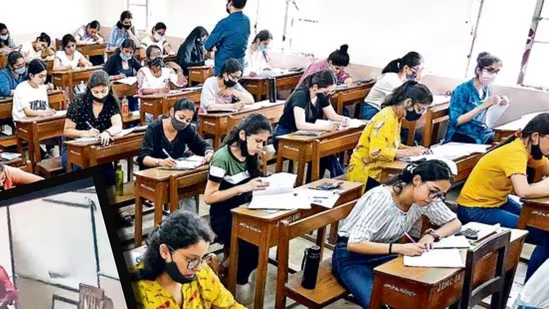






















The results of this year’s Secondary School Leaving Certificate (SSLC) examinations were declared on Thursday with 94.1% students passing, amid the ongoing dispute over the mechanism to evaluate third language subject papers.
The issue began after a government announcement on March 27 that, starting this academic year, the third language paper would be assessed using a grading system instead of marks. The change was intended to ensure that the subject would not affect a student’s overall result and was announced before the examination. The decision was challenged in court, and the high court directed that marks – not grades – be awarded for the third language this year.
Officials said that the examinations logged a 99.2% attendance rate this year. 770,209 students appeared out of 775,999 registered. A total of 724,794 students cleared the examinations, which reflected in a 94.1% pass percentage, they added.
Officials said that although the results reflected a clear improvement from the 80.04% overall pass percentage recorded last year across three examination cycles, 1,425 students failed only in the third language category.
The SSLC examinations were conducted between March 18 and April 2, and answer scripts were evaluated at 237 centres. The evaluation process was completed on April 16. “The results are historical, and the students performed well. I compliment and congratulate students, parents, teachers and department officials,” said minister for school education and literacy, Madhu Bangarappa.
Seven students secured full marks— 625 out of 625— emerging as state toppers. Among them was Prathana Biradar Patil, who credited her success to attentive classroom learning and consistent revision. “I was studying normally like all students. I came first in the state and I would like to thank our teachers. I will continue my studies in the science department. I did not put much effort into this achievement. I learned it while the teacher was teaching the lesson and came home and re-studied again, which made it possible to get so many marks,” she said.
Girls recorded a better overall performance than boys, with a pass percentage 96.18%. “Though girls are number one, I want to congratulate boys as they have improved their performance; there is a 17.69% increase in boys’ performance compared to last year,” said Bangarappa.
Students in rural areas recorded a pass percentage of 94.80%, higher than the 93.2% reported in urban areas, said officials, adding that government schools saw a 16.8% increase in pass rates compared to last year. “I am happy to share that more than 50% of government schools have secured 100% results,” Bangarappa said.
“66.5% of students have achieved 60% and above (distinction),” he said, adding that 1,532 students benefited from the reduction of the minimum passing requirement from 35% to 33%.
Dakshina Kannada and Udupi districts recorded pass percentages of 98.40% and 98.18% respectively, the highest in the state. Kalaburagi recorded the lowest at 85.06, though it improved compared to last year, along with Yadgir.
Officials said digital mark cards are being made available through DigiLocker for the first time. Students who wish to improve their scores can appear for a second round of examinations scheduled from May 18 to 25. Authorities said no third examination will be conducted this year due to the high overall pass percentage.



