











Former South Korean President Yoon Suk Yeol was found guilty of leading an insurrection and sentenced to life in prison over his 2024 martial law declaration that shocked the nation and triggered the country’s most severe political crisis in decades.
The verdict marks the conclusion of one of the most consequential judicial proceedings involving a former South Korean president, with the martial law episode garnering attention as a test of the country’s democratic health. The incident dredged up memories of former leader Chun Doo-Hwan, who was sentenced to death over an attempted coup in the late 1970s. Chun was ultimately pardoned.
The Seoul Central District Court handed down the guilty sentence Thursday after prosecutors sought the death penalty on grounds that Yoon posed a grave threat to the country’s constitutional order.
“Yoon’s imposition of emergency martial law damaged the constitutional order by mobilizing military forces in an attempt to blockade the National Assembly,” the court said while convicting Yoon of leading an insurrection.
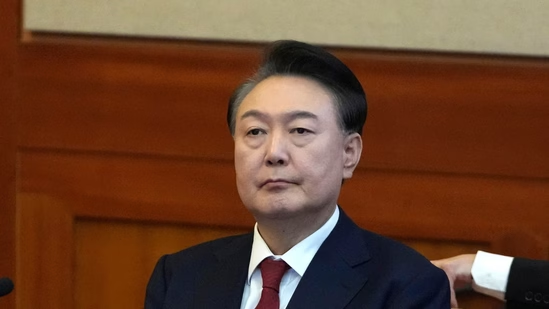
Yoon arrived at the near-packed courtroom wearing a dark blue jacket and a shirt and sat impassively, and the verdict was delivered about an hour later.
Yoon, 65, was indicted last year on charges of insurrection after suspending civilian rule in early December. The short-lived decree led to his impeachment and the first arrest and indictment of a sitting South Korean president.
The former leader can appeal the ruling. Any appeal would proceed to a higher court and could take months to resolve.
Yoon has denied any wrongdoing, saying his declaration was a desperate bid to counter what he claimed were North Korea sympathizers trying to paralyze his administration. At the final hearing in January, he said public opposition to his impeachment made him feel the “emergency alarm” he sounded had been effective.
A former top prosecutor, Yoon rose to the presidency promising to revive a Covid-hit economy and take a more hawkish stance on North Korea and China. But his political gamble upended his administration, ending his tenure and paving the way for elections. The more progressive President Lee Jae Myung swept to power in June.
“I would say that perhaps 70% or more of the public agrees that the declaration of martial law was wrong,” Park Won-ho, a political science professor at Seoul National University said by phone, before the verdict.
“Holding him accountable in some form is therefore an important step, and that may be what we are witnessing today. My sense is that once the verdict is delivered, there may be a degree of closure, and the situation could begin to settle,” Park added.
The verdict may give Lee more room to focus on his policy agenda while the main opposition People Power Party grapples with the latest fallout from the martial law fiasco. Lee still needs bipartisan support as he tries to heal a divided nation and protect the export-reliant economy from President Donald Trump’s tariff pressure.
“In a way, this feels like the closing of a chapter — a chapter that began on Dec. 3, 2024, when martial law was declared. Since then, we’ve gone through a very complicated process with many twists and turns, but now the Korean judicial system is in a position to provide an answer,” Park added.



