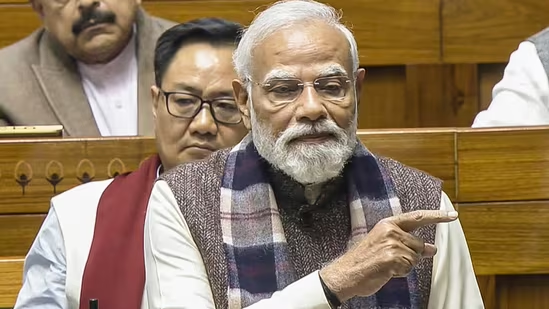


























Prime Minister Narendra Modi on Monday launched a sharp attack on the Congress during a Lok Sabha debate marking 150 years of Vande Mataram, accusing former prime minister Jawaharlal Nehru of echoing Muhammad Ali Jinnah’s opposition to the national song and “pandering to communal concerns”.
Initiating the discussion, PM Modi said Nehru had once written to Netaji Subhas Chandra Bose that Vande Mataram might “provoke and irritate Muslims”, and suggested examining its usage. “This, despite Vande Mataram being born in Bankim Chandra’s Bengal,” he said.
The Prime Minister also linked the national song to the Emergency imposed by Indira Gandhi in 1975, asserting that when Vande Mataram completed 100 years, “the Constitution was throttled and those who lived for patriotism were put behind bars”.
“The Emergency was a dark chapter in our history. Now we have the opportunity to restore the greatness of Vande Mataram. That opportunity should not be allowed to pass,” Modi told the House.
‘Rock of resistance’
PM Modi described Vande Mataram as the mantra that “energised and inspired India’s freedom movement”, noting that even when the British banned its printing and propagation, the song “stood like a rock” against oppression.
“After the 1857 uprising, the British pushed ‘God Save the Queen’ into every household. Bankim Chandra Chattopadhyay responded with Vande Mataram, and despite the partition of Bengal in 1905, it unified the country,” he said.
The Vande Mataram controversy
The BJP has repeatedly slammed the Congress for its 1937 decision to adopt only the first two stanzas of the song in national gatherings – seen by some Muslim leaders of the time as less religiously symbolic than later verses invoking Hindu goddesses Durga, Lakshmi and Saraswati.
PM Modi said the move “sowed the seeds of division” that culminated in Partition.
“When Vande Mataram celebrated 100 years, the country was entangled in the Emergency… Now, at 150 years, it is our duty to restore its glory,” he added.
The row resurfaced last month after BJP leaders cited letters Nehru wrote to Bose in 1937, arguing that his approach signalled a willingness to restrict the song to appease communal sensitivities — a claim the Congress has previously rejected, saying Nehru insisted the lyrics were “harmless” and should not be interpreted as referring to goddesses.
‘Historic moment’
Modi framed the anniversary alongside other major national commemorations: “We recently celebrated 75 years of our Constitution, 150 years of Sardar Patel and Birsa Munda, and the 350th martyrdom of Guru Teg Bahadur. Now we celebrate 150 years of Vande Mataram.”
The Prime Minister concluded that remembering the song in Parliament today was “a great privilege for all of us”.



