





















The last remaining nuclear arms pact, the New START treaty, between Russia and the United States expired on Thursday, raising concerns over the risk of a new arms race between the world’s two largest nuclear powers at a time when geopolitical tensions are at an all-time high.
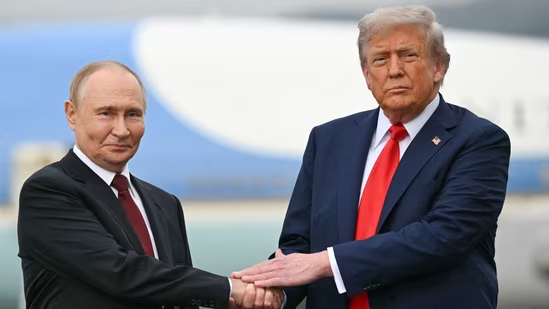
With the treaty coming to an end, the two countries are no longer subject to any restrictions on the scale of their strategic nuclear weapons. Russian President Vladimir Putin said last year that Moscow was willing to observe the treaty limits for another year if Washington did the same. However, US President Donald Trump has not made it clear whether he supports an extension.
Trump has also said he wants China included in the arrangement, a proposal that Beijing has rejected. On Thursday, China described the expiry of the agreement as “regrettable” and said it continues to strictly follow a nuclear policy based on self-defence.
What is the New START treaty?
The Strategic Arms Reduction Treaty, known as New START, was signed by then US President Barack Obama and Russia’s Dmitri Medvedev in 2010. It came into force in 2011.
It placed caps on the nuclear arsenals of Russia and the United States and provided for inspections and the sharing of information between the two sides.
Its end leaves both Moscow and Washington without any system to manage their strategic nuclear stockpiles for the first time since the height of the Cold War in the 1980s.
The end of the New START treaty raises concerns that it could open the door to an unchecked nuclear arms race.
The agreement set a cap of 1,550 deployed strategic nuclear warheads for each side and put in place transparency measures such as data sharing, notifications and on-site inspections.
The agreement was initially set to end in 2021 but was later extended by another five years.
Russia’s Putin and America’s Trump on the treaty
The Kremlin said on Thursday that the expiry of the New START treaty was a negative development, but added that Russia would continue to take a responsible stance on maintaining strategic stability.
Russian President Vladimir Putin discussed the expiry of the pact with Chinese leader Xi Jinping on Wednesday, Kremlin adviser Yuri Ushakov said. He added that Washington had not responded to Putin’s proposal to extend the agreement.
Ushakov said Russia “will act in a balanced and responsible manner based on thorough analysis of the security situation”.
In a statement issued late on Wednesday, Russia’s foreign ministry said that “under the current circumstances, we assume that the parties to the New START Treaty are no longer bound by any obligations or symmetrical declarations within the context of the treaty, including its core provisions, and are fundamentally free to choose their next steps”.
Trump has said he supports keeping limits on nuclear weapons but wants China included in any future agreement.
“I actually feel strongly that if we’re going to do it, I think China should be a member of the extension,” Trump told The New York Times last month. “China should be a part of the agreement.”
Trump did not issue any comment when the treaty expired. The White House said earlier this week that Trump would determine the next steps on nuclear arms control and would “clarify on his own timeline”.
UN worried over expiration of treaty, China ‘concerned’
UN Secretary-General Antonio Guterres said the breakdown of decades of progress in arms control “could not come at a worse time, the risk of a nuclear weapon being used is the highest in decades”.
He called on Russia and the US to restart talks immediately to agree on “a successor framework that restores verifiable limits, reduces risks, and strengthens our common security”.
The North Atlantic Treaty Organization (NATO) also issued a call for “responsibility and restraint” as the agreement between the United States and Russia, which placed limits on their nuclear stockpiles, came to an end. The alliance warned that its lapse had heightened concerns about a renewed arms race.
“Restraint and responsibility in the nuclear domain is crucial to global security,” an official from the US-led military alliance said, speaking on condition of anonymity.
Meanwhile, China has resisted any limits on its smaller but expanding nuclear stockpile, while calling on the US to resume nuclear discussions with Russia.
“The international community is generally concerned that the expiration of the treaty will have a negative impact on the international nuclear arms control system and the global nuclear order,” China’s foreign ministry said.
Chinese foreign ministry spokesperson Lin Jian said China follows a self-defence nuclear policy. “China has consistently adhered to a self-defence nuclear strategy, abided by the policy of no first use of nuclear weapons and has made unconditional commitments not to use or threaten to use nuclear weapons against non-nuclear-weapon states or nuclear-weapon-free zones,” Lin said.
Should the world be worried about the end of the treaty?
What is concerning is that the treaty has expired at a time when geopolitical tensions are at an all-time high.
The Russia-Ukraine conflict is ongoing, even as ceasefire talks continue. Tensions have also continued over Greenland, while the situation in Gaza remains unstable. Strains between the United States and Iran have also not eased despite ongoing negotiations.
The immediate consequences could put pressure on the 1970 nuclear non-proliferation treaty, which is due for a review later this year. The end of the US-Russia agreement has weakened the base on which the treaty is built.
Pavel Podvig, a senior researcher at the United Nations Institute for Disarmament Research in Geneva, told Bloomberg that the expiration of the treaty “definitely doesn’t make the world safer” and that the “real loss will be a loss of transparency and it will increase political risks”.



