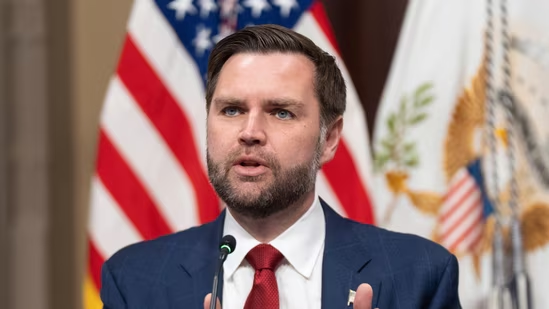














US Vice President JD Vance on Wednesday described the Russia-Ukraine war as the “hardest” conflict to resolve. Speaking during a visit to Budapest, Vance said the US would “keep on working” to end the war, now entering its fifth year since Russia’s full-scale invasion of Ukraine in February 2022.
“What the president [Donald Trump] has said is that it’s the hardest war to solve. In some ways, we thought it would be the easiest, but it has been the hardest,” Vance said, adding that there has been “significant progress”.
Vance said both Moscow and Kyiv would ultimately need to make difficult decisions to end the war. He appeared to suggest that territorial compromises may be necessary.
“We’re talking about haggling at this point over a few square kilometres of territory… Is that worth losing hundreds of thousands of additional Russian and Ukrainian young men?” he said.
“The answer is clearly no. But it takes two to tango… we can only open the door. The Russians and the Ukrainians have to walk through it,” Vance said.
Last Sunday, Ukrainian President Volodymyr Zelensky said he would ask US mediators to pass on a proposal for an Easter ceasefire to Russia. Speaking on the sidelines of an event on the anniversary of the Bucha killings, Zelensky said Ukraine was ready to pause attacks on energy infrastructure during the holiday period.
He said he would raise the proposal in talks with US envoys, asking them to convey it to Moscow. Kremlin spokesman Dmitry Peskov said Moscow had not seen a clear or formal proposal from Kyiv, as per Al Jazeera.
Diplomatic efforts by the US
Despite multiple rounds of US-backed talks this year, there has been no major breakthrough. A first round of trilateral discussions in January was described as “constructive”, followed by a second round in early February in Abu Dhabi, where both sides agreed to a prisoner exchange and to continue negotiations.
A new round of talks expected this month has been delayed.
The talks included senior officials from both countries, with US representatives playing a mediating role and helping shape discussions.
Major dispute over territory
The biggest obstacle remains the territory in eastern Ukraine. Russia continues to demand control over parts of the Donbas region that it does not fully occupy.
Zelensky has rejected any deal that would involve giving up land, saying it would violate Ukraine’s constitution.
Ukraine believes it can continue defending key areas in the region, pointing to slow Russian advances in recent years.
Moscow has pushed for recognition of its control over occupied areas, while Ukraine insists on preserving its territorial integrity.
Russia-Ukraine ceasefire terms
Ceasefire terms remain disputed. Kyiv wants a long ceasefire to support peace talks, but Russia has avoided agreeing to a lasting pause in fighting.
Security guarantees are another key issue. Ukraine wants firm promises from Western allies to prevent future attacks, while Russia opposes any deal that increases Western military presence or expands NATO.
JD Vance backs Hungary, criticises Europe
Hungary has blocked a major proposed loan package for Kyiv.
JD Vance, during his Budapest visit, strongly backed Hungarian Prime Minister Viktor Orban, calling him an “important partner for peace”. He said many European leaders have not done enough to push negotiations.
He also dismissed criticism of Hungary within the European Union and said his visit ahead of an election was “unprecedented”.
“We wanted to show that Orban has strong support from friends around the world,” he said.
Vance named Italian Prime Minister Giorgia Meloni as one of the leaders who have supported peace efforts.



