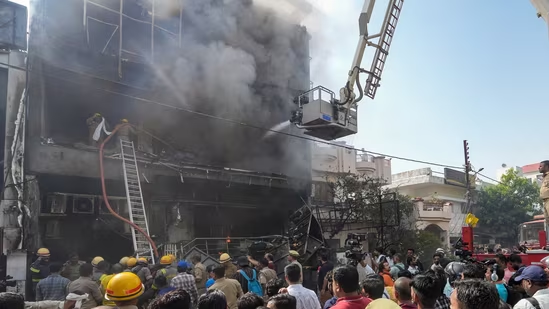






















Fifteen people were killed and nine others injured when a massive fire ripped through a coaching centre in Lucknow’s Aliganj area on Monday.
What initially appeared to be an accidental fire is now under scrutiny for a series of violations in the commercial building that authorities say had been ignored for years.
A residential building operating as a commercial hub
The three-storey building on Usha Mehta Marg was originally approved for residential use. It was still functioning as a commercial establishment housing multiple businesses, including a pet shop, veterinary clinic, gaming zone, animation centre and an IT office.
According to government records, the property was approved under a self-certification building plan scheme in 2014 for residential purposes. Authorities later detected unauthorised construction on the premises.
The Lucknow Development Authority (LDA) then initiated proceedings against the owners and issued a demolition order in May 2016. That order was revoked less than two months later in July 2016, allowing the structure to continue operating.
Following the June 22 fire, the LDA has once again issued a demolition notice and launched an inquiry into officials whose alleged inaction may have enabled the building’s continued use despite known violations.

A death trap with only one exit
The structure had only one entry and exit point, the FIR filed by police says. There was no emergency staircase, secondary exit, or alternative route for occupants trying to escape during a fire.
As smoke spread rapidly through the building, people inside became trapped. Many jumped down to escape the fire, HT reported earlier. Rescue personnel eventually had to break through walls and access the building from adjoining properties to reach victims.
No fire safety measures in place
Police have alleged that the owners and operators failed to put in place basic fire safety arrangements despite running several commercial establishments from the premises.
The FIR claims there were no adequate systems to deal with emergencies, no proper evacuation provisions and no measures that could have limited the spread of the fire or protected occupants.
The height loophole
Another aspect attracting attention is a provision in building regulations that exempted the structure from obtaining a fire No Objection Certificate (NoC).
According to fire department officials, the building was shorter than 15 metres, the threshold above which structures are required to obtain mandatory fire clearance and comply with stricter fire safety norms. Because it fell below that limit, the building did not require a fire NoC and was never inspected from that perspective.

Officials now acknowledge that the same rule may have created a loophole that allowed significant safety concerns to remain undetected.
Smoke accumulation turned deadly
Officials believe smoke inhalation played a major role in the deaths. Preliminary findings suggest the fire may have started in an AC duct, Uttar Pradesh urban development and energy minister AK Sharma said, as per PTI. Once the blaze broke out, smoke quickly filled the building.
Investigators found no effective smoke extraction or ventilation system that could have allowed toxic fumes to escape.
Unsafe electrical installations
Authorities are also examining the building’s electrical setup.
According to the FIR, electrical arrangements inside the structure were “highly irregular”. AC outdoor units and electrical equipment were allegedly installed in an unsafe manner.
Legal action
Police have registered an FIR under charges including culpable homicide not amounting to murder, attempt to commit culpable homicide, rash and negligent acts endangering human life, and provisions of the Uttar Pradesh Fire and Emergency Services Act.
Among those arrested are building owner Virendra Prasad Shukla, pet shop operator Ram Krishna Upadhyay, animation centre operator Tushar Krishna Jaiswal and Suresh Kumar Sahoo. Investigators are also probing the role of other unnamed individuals.
The Uttar Pradesh government has constituted a two-member Special Investigation Team (SIT), which has been asked to submit its findings within seven days.



