

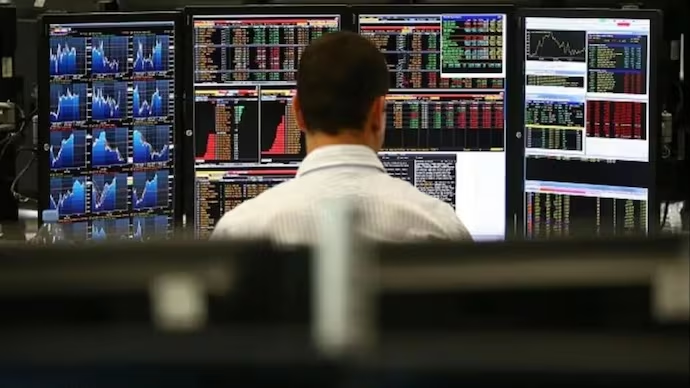

























Equity benchmarks extended their decline on Tuesday, as the expiry of the temporary US-Iran ceasefire raised fears of a fresh escalation in the Middle East. Higher crude oil prices and weakness in IT stocks weighed on investor sentiment, keeping the market under pressure for another session.
The BSE Sensex opened at 77,418.97, down 309.19 points from the previous close. By 9:44 am, it was down 261.04 points, or 0.34%, at 77,467.12. The index moved between a high of 77,575.21 and a low of 77,362.19.
The Nifty 50 opened at 24,223.85 and was down 55.50 points, or 0.23%, at 24,232.15 as of 9:44 am. It touched an early high of 24,269.65 and a low of 24,211.10.
The weakness followed a cautious start to the week, with investors tracking developments in the Middle East and the impact of higher energy prices on India’s economy.
CRUDE OIL BACK ABOVE $91
The biggest concern for investors remains crude oil. Brent crude has moved back above $91 a barrel as hopes of an extension of the temporary US-Iran ceasefire faded.
Iran has indicated that it could adopt a more offensive posture, while US President Donald Trump has ruled out an extension of the ceasefire arrangement. The developments have raised concerns about possible disruption to energy supplies.
For India, higher crude prices are a concern as the country is a major oil importer. A sustained rise in oil prices could increase import costs and put pressure on inflation, corporate margins and the broader economy.
Dr VK Vijayakumar, Chief Investment Strategist at Geojit Investments Limited, said two developments were likely to influence the market, especially in early trade.
“One, Brent crude has again spiked above $91 on escalation of tensions between Iran and the U.S. Two, the U.S. 10-year bond yield has increased to 4.73% and this is negative for FII inflows which had turned positive in July and August so far,” he said.
IT STOCKS LEAD THE FALL
IT stocks were among the biggest drags on the benchmark indices. The Nifty IT index fell 1.24% in early trade.
Among the major Sensex stocks, Infosys was the biggest loser, down 1.58%. Asian Paints fell 1.59%, while HCLTech declined 1.18% and Tech Mahindra dropped 1.09%.
TCS was down 0.94%, while LT fell 0.56%. The weakness in large IT names added to the pressure on the Nifty.
The broader IT and telecom index was also down 0.65%, showing that the pressure was not limited to the largest IT companies.
SENSEX GAINERS AND LOSERS
The Sensex had more losers than gainers in early trade. Among the stocks that gained, Sun Pharma was up 0.64%, while Reliance Industries and Axis Bank gained 0.55% each. Tata Steel rose 0.27%, Maruti gained 0.25% and M&M was up 0.24%.
Eternal rose 0.24%, NTPC gained 0.21%, Bajaj Finance added 0.14% and Power Grid was up 0.13%.
On the losing side, Asian Paints fell 1.59%, Infosys declined 1.58%, HCLTech dropped 1.18%, Tech Mahindra lost 1.09%, TCS fell 0.94% and Hindustan Unilever declined 0.88%.
IndiGo and Bharti Airtel were also down 1.49% each, while Adani Ports fell 0.74% and Ultratech Cement declined 0.57%.
REALTY, FINANCIALS ALSO UNDER PRESSURE
The weakness was visible across several parts of the market. The Nifty Realty index fell 1.60%, while Nifty Financial Services Ex-Bank declined 0.56% and Nifty Midcap Financial Services dropped 0.75%.
Nifty PSU Bank fell 0.36%, while Nifty Financial Services 25/50 declined 0.37%. Nifty FMCG was down 0.14% and Nifty Media fell 0.14%.
There were some pockets of strength. Nifty Pharma gained 0.51%, Nifty Healthcare rose 0.43% and Nifty Auto added 0.32%. Nifty Oil & Gas was also up 0.64%, while Nifty Consumer Durables gained 0.13%.
BROADER MARKET ALSO WEAK
The broader market remained under pressure, although small-cap stocks were relatively resilient.
The Nifty 100 fell 0.19%, while the Nifty 200 and Nifty 500 declined 0.25% and 0.21%, respectively. The Nifty Midcap 50 dropped 0.43% and the Nifty Midcap 100 fell 0.47%.
The Nifty Smallcap 100, however, was up 0.04%.
The India VIX, which tracks expected market volatility, rose 0.52% to 11.39, reflecting some increase in caution among investors.
DIIs MAY PROVIDE SUPPORT
Despite the near-term pressure, Vijayakumar said the Indian economy remains resilient and there are clear signs of a turnaround in earnings growth.
“The tailwind for the market is the resilient Indian economy and clear indications of a turnaround in earnings growth. This tailwind will encourage DIIs, flush with funds, to buy any significant dip in the market,” he said.
He added that retail investors could use market declines to gradually accumulate high-quality stocks for the long term, while warning that heightened uncertainty is likely to keep markets volatile.
“Retail investors can use the dips in the market to slowly accumulate high quality stocks for the long-term. Heightened uncertainty will keep the market volatile,” Vijayakumar said.



