
























H Vinoth’s Vijay-starrer Jana Nayagan, touted as the Tamil star’s last film before he enters politics, has been stuck with the Central Board of Film Certification (CBFC). Amid this, the Ministry of Information and Broadcasting (MIB) informed the Lok Sabha that the average time for a film to be certified has dropped to 18 days. The MIB also released data about the number of films challenged before the revising committee (RC) or the High Court (HC).
CBFC censor time dropped to 18 days, says MIB
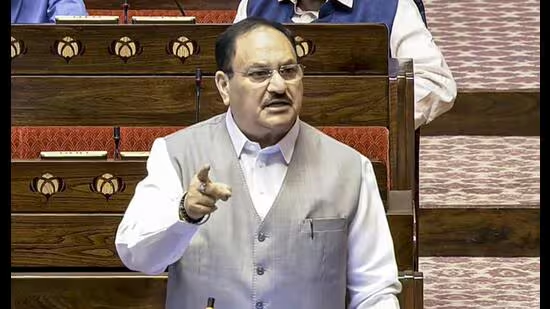
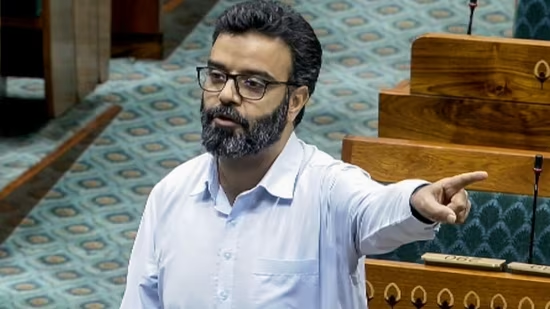
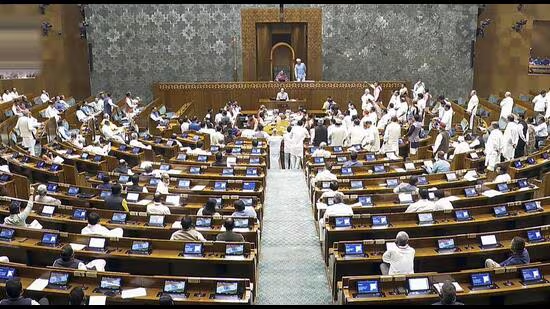
Minister of State for Information and Broadcasting and Parliamentary Affairs L Murugan responded to a question posed by Priyanka Gandhi Vadra in the Lok Sabha. He stated that the CBFC now takes an average of 18 days to censor films due to the implementation of the Online Certificate System. This is below the prescribed time limit for film certification, which is 48 days. Short films are now being censored in 3 days.
The CBFC operates according to the Cinematograph Act, 1952, and the Cinematograph (Certification) Rules, 2024. The MIB also released data on the number of films certified each year, along with the number challenged before the RC and HC since the abolition of the Film Certification Appellate Tribunal (FCAT) in 2021. According to the ministry, the time taken by the RC to review films is within the timeframe specified in Rule 37(7) of the Cinematograph (Certification) Rules, 2024. Data of films certified as per the PIB website:
| Year | 2021-2022 | 2022-2023 | 2023-2024 | 2024-2025 | 2025-2025 (till date) |
|---|---|---|---|---|---|
| Total films certified | 2031 | 2777 | 2837 | 2687 | 2248 |
| Challenged before RC | 25 | 46 | 49 | 38 | 55 |
| Challenged before HC | 2 | 4 | 1 | 4 | 10 |
Which films are required to make cuts and modifications
RC is also used as a multi-level grievance redress mechanism, with applicants able to appeal to it. “Cuts or modifications are recommended only if the content violates statutory parameters concerning sovereignty and integrity of India, security, public order, decency, morality, defamation, contempt of court or incitement to offence,” they clarified.
If the filmmakers disagree with the board’s decision, the Cinematograph Act provides for an appeal against the board’s order before the HC. “The Government is committed to maintaining a transparent and accountable certification process, while protecting creative freedom and discharging its obligations under the Cinematograph Act,” said the ministry.
The Jana Nayagan censor row
Jana Nayagan’s producer, KVN Productions, claimed that he submitted the film to the CBFC on December 18. On December 22, he was informed by the examining committee that the film would be certified UA 16+ in accordance with 14 cuts and modifications. After not hearing back from the censor board, the producer files a plea at the Madras HC to expedite the process. He is informed that the film is being sent to the revising committee.
After a single judge asked the CBFC to certify the film, the board got a stay from an HC bench on the order. The producer moved the Supreme Court (SC) but was asked to seek relief at the HC. There has been no relief for the Jana Nayagan team so far, as the bench heard both sides and sent the matter back to a single-judge bench. Both the CBFC and the film’s producer have refused to confirm if the film was sent to a revising committee after that.



