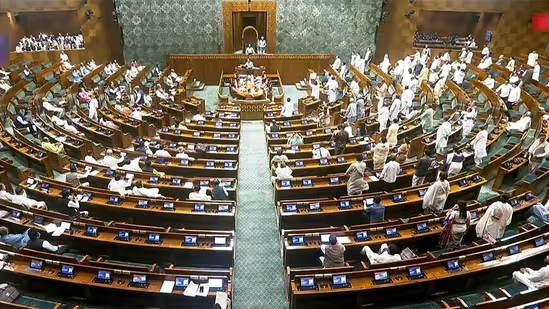






















The Joint Committee reviewing the Constitution amendment bill to remove arrested ministers is set to recommend a sunset provision — an automatic reversal clause— in the bill to allow reappointment of ministers for failure of the prosecution to proceed within a defined period, people familiar with the details said.
The provision, the people added, asking not to be named, can be a safeguard in an otherwise controversial legislation. The panel, led by Bharatiya Janata Party lawmaker Aparajita Sarangi, is likely to make at least five key recommendations to the government.
What is the reversal clause
One of them is the automatic reversal clause and the people cited above said it is to ensure that the minister’s removal will lapse upon their discharge, acquittal, or failure of the prosecution to proceed within a defined period.
The clause will ensure that removal founded on an unproven allegation does not become a de facto permanent disability.
In other words, if a minister is removed from office following his arrest but is later acquitted by the court then that person is eligible for re-appointment and does not permanently lose their position.
On monsoon session agenda
Union home minister Amit Shah tabled the 130th Constitution amendment bill and two supplementary legislations for J&K and the other UTs in August last year. The Opposition objected to the bill and several parties refused to be a part of the joint committee to review the bill as a mark of protest.
The government has indicated that the legislation is high on its agenda for the upcoming monsoon session.
The panel might recommend to the government define the term “serious criminal offences” and keep the provision for fast-track/special courts for trial of cases against high constitutional functionaries consistent.
In a second change, the panel might ask the government to incorporate a separate “schedule of offences” punishable with imprisonment for a term of five years or more, in the three bills.
A third change the panel is considering is replacing the terms “removal” and “cease to be a minister” with “suspension”.
The panel might recommend the government to define the term “serious criminal offences” and keep the provision for fast-track/special courts for trial of cases against high constitutional functionaries consistent.
Defending the bills before the panel, the Union home ministry argued that the legislative measure “addresses a critical gap in the existing constitutional and statutory frameworks concerning the accountability of holders of high public office specifically, the Prime Minister, chief ministers, and ministers”.
The ministry maintained that the proposed amendments are in sync with a commitment to reinforce constitutional morality, ethical governance, and public trust in democratic institutions.
Oppn objects bill
Many Opposition members questioned the government’s intent and argued that under the stringent Prevention of Money Laundering Act or Unlawful Activities Prevention Act, chances of getting bail is almost nil and the proposed law could be misused for removing elected ministers and destabilizing non-NDA governments.
The ministry, however, argued that Section 187 of BNSS permits magisterial authorization of detention initially up to 15 days in police custody– in whole or parts during the first 40 or 60 days — depending on offence severity, and extends judicial custody up to a total of 60 days (investigations into offences punishable by less than 10 years) or 90 days (investigations into offences punishable by more than 10 years).
When asked by members on why the bill adds the proviso of a five-year jail term, the home ministry maintained that the first schedule to the BNSS, 2023, contains classification of offences in respect of Bharatiya Nyaya Sanhita 2023 (BNS, 2023) and offence against other laws. In the classification of offences, most offences punishable with imprisonment for less than three years or with a fine only have been categorized as non-cognizable and bailable and may be tried by any magistrate. Most offences punishable with imprisonment for three years and upwards but not more than seven years have been categorized as cognizable and non-bailable and to be tried by a magistrate of the first class.
In an earlier meeting, Opposition members questioned the government’s intent and said that the new law could remove chief ministers of Karnataka, Jharkhand and Telangana– all of whom have cases pending against them .


