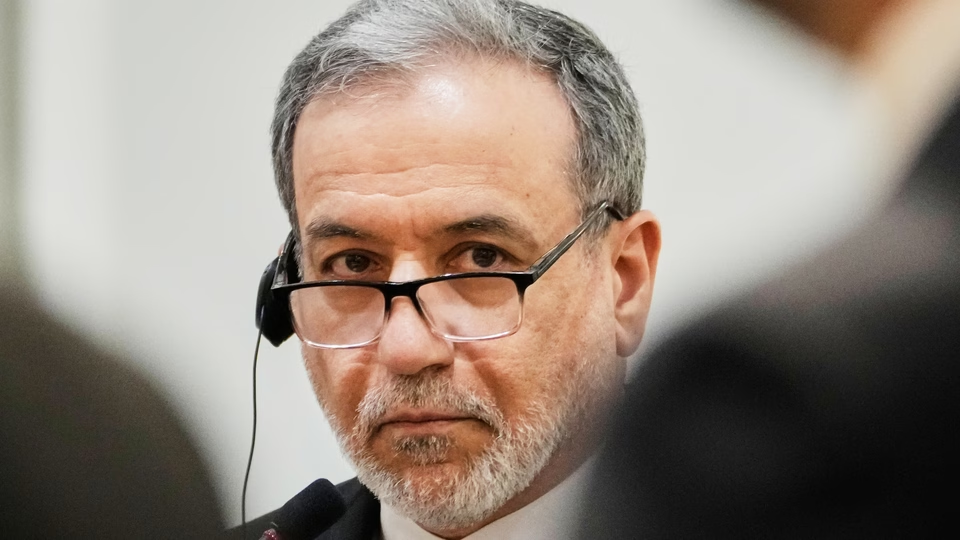



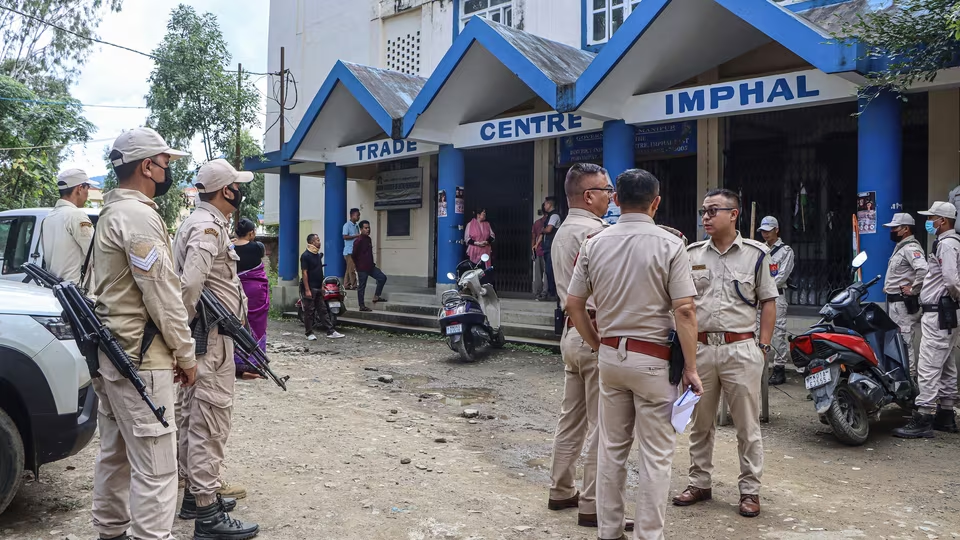



















A meeting involving Iran and other Gulf littoral states was postponed on Sunday following attacks on an Iranian cargo ship near Qeshm Island.
The meeting was scheduled in Muscat to discuss regional issues, including safe shipping routes through the Strait of Hormuz under an Iran-Oman arrangement.
Omani foreign minister Badr Albusaidi said the meeting was postponed “in the interests of consensus”. “We remain committed to fostering dialogue that supports stability and lasting cooperation in our region,” he wrote on X.
An Iranian foreign ministry official said the decision was taken jointly by Tehran and Muscat at the request of some regional countries.
Iran will coordinate with Oman to set a new date, the official said, as per AFP.
Iran and Oman recently agreed on new shipping routes through the Strait of Hormuz, semi-official Tasnim news agency reported. The entry route would run entirely through Iranian waters, while part of the exit route would also be in Iranian waters.
The details were to be presented to other Gulf countries at the now-postponed meeting in Oman. The new arrangement would not mean the strait is reopening, as Iran said it had seven conditions for reopening the waterway.
Attack on Iranian cargo ship kills 1
An Iranian commercial vessel was hit early Sunday near Hormuz, Iranian state media said. One person was killed and four crew were wounded.
Iranian state-run IRNA quoted the Qeshm governor as blaming a “terrorist enemy” for the attack.
The UK Maritime Trade Operations agency, or UKMTO, said a vessel was struck by a projectile while sailing through the Strait of Hormuz. A fire broke out and the crew was evacuated, it said. It was not immediately clear whether the incident was the same attack reported by Iran.
Iran insists on conditions for reopening Hormuz
Iran has said shipping through the Strait of Hormuz would be managed under an agreement with Oman.
Iranian officials said ships entering the Persian Gulf would pass through Iranian waters. Outbound traffic would use both Iranian and Omani waters. Tehran has also expressed interest in charging ships fees for transit.
But Iranian foreign minister Abbas Araghchi said Iran would not reopen the strait until the US met its demands, despite any agreement with Oman.
Commercial traffic through the strait remains low. The waterway is one of the world’s most important oil transit routes.
Before the talks were postponed, Iraq was the only country to publicly confirm that it planned to attend, as per Iraqi media. Bahrain said it would not participate because it did not have diplomatic relations with Tehran.
Saudi Arabia has also sought changes to the Iran-Oman agreement. A Gulf official familiar with the matter said Riyadh was concerned that the deal could have long-term implications for the Strait of Hormuz and other Gulf Cooperation Council countries.
Trump says Iran wants a deal
Iranian President Masoud Pezeshkian, ahead of the planned talks, said Iran could not be bullied. “Our people can’t be bullied into submission. Iran won’t surrender,” he said on social media.
US President Donald Trump said Iran wanted to reach a deal. “Iran wants to make a deal so bad,” Trump said Sunday. He claimed Iranian officials were “calling constantly”.
He said he still expected the war on Iran to end this year. Asked whether the US struck the Iranian cargo vessel near the Strait of Hormuz, Trump said, “I don’t want to say.”
Iran and UAE discuss tensions
Pezeshkian earlier said he had a “good talk” with a senior UAE official on the sidelines of the BRICS summit in India. He met Abu Dhabi Crown Prince Sheikh Khaled bin Mohamed bin Zayed.
“We talked about the issues of concern so that it’s possible to put the past behind us, to look toward the future and how we can build the future together,” Pezeshkian said on Iranian state television.
Iran has fired thousands of missiles and drones at the US bases in UAE after Trump ordered attacks on the West Asian country. Tehran claimed its attacks were aimed at US military assets in the region.
Oil prices jump
The attacks near Hormuz came as oil supplies faced another major disruption. Saudi Arabia kept its key 1,200-km east-west oil pipeline closed after Friday’s drone strikes damaged it.
Oil prices rose when markets reopened on Monday, Reuters reported.
The pipeline helps Saudi Arabia export oil without using the Strait of Hormuz. Saudi has enough oil stored at its Red Sea port of Yanbu to keep exports going for about five to seven days if the pipeline stays shut.
A longer shutdown could put up to 4% of global oil supply at risk, adding to the millions of barrels already disrupted by lower traffic through Hormuz.
Saudi has not said how badly the pipeline was damaged or when it will be repaired. Oil prices crossed $100 a barrel last week, while US diesel prices hit a record above $6.20 a gallon.



