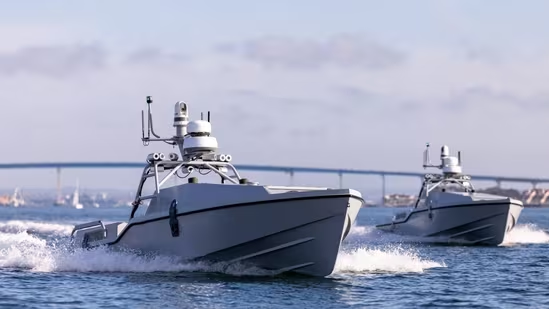











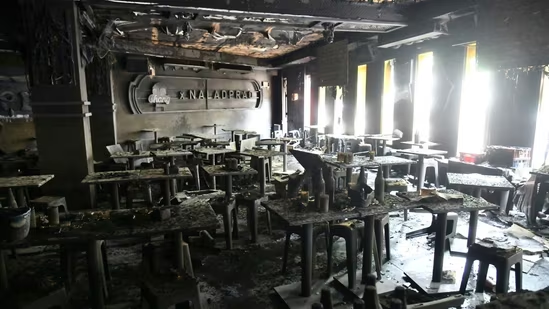


















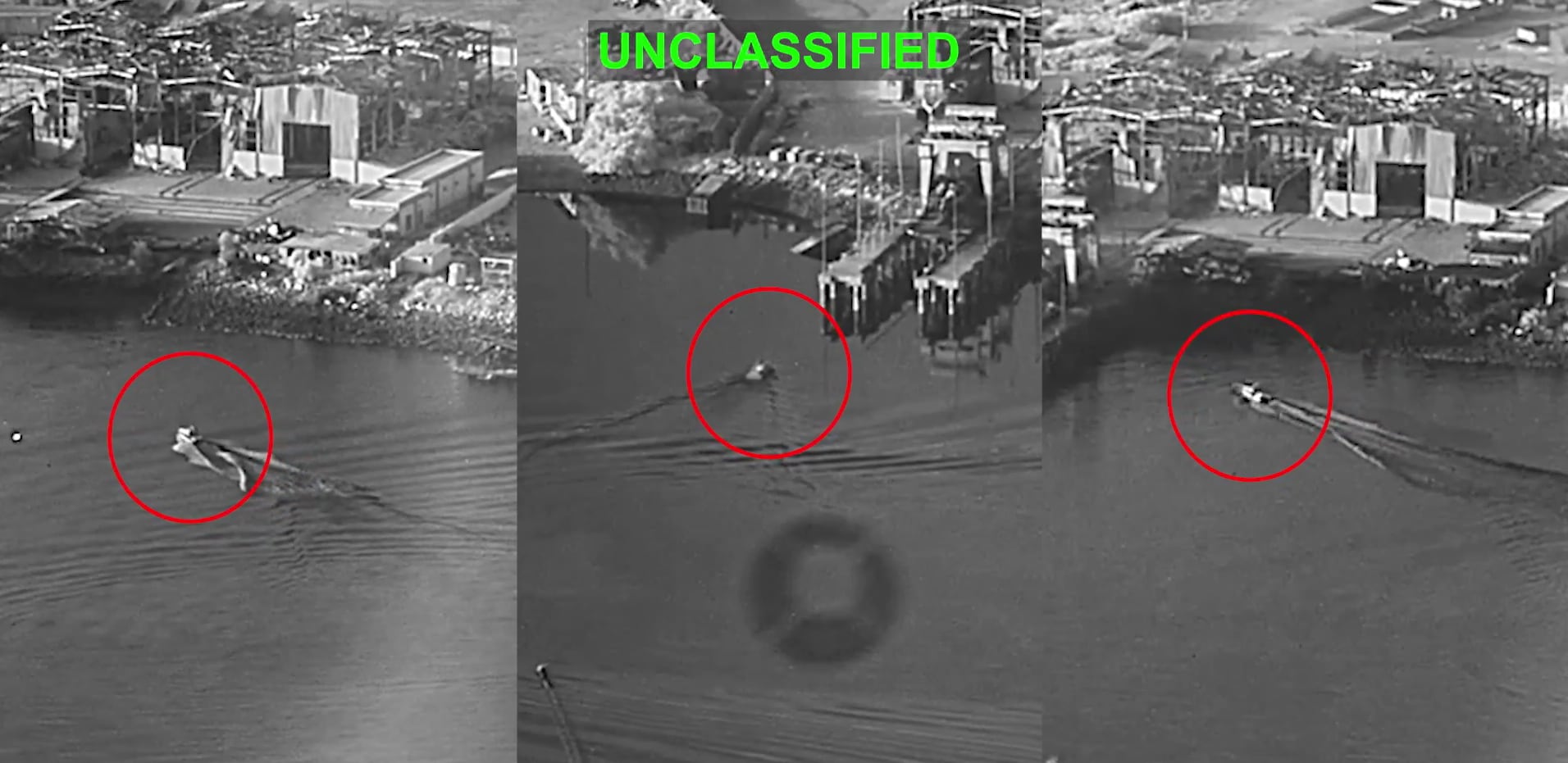
In a first, the US deployed Corsair unmanned surface vessels (USVs) in an attack on an Iranian structures. The armed maritime drones were used to strike a submarine and ship maintenance facility at Iran’s Bandar Abbas naval base on Sunday, the Pentagon said.
Three Corsair sea drones carried out the attack, according to the US Central Command (CENTCOM). The command also released footage showing one of the autonomous vessels speeding across the water towards a dock before detonating on impact.
The US war on Iran has already seen the US deploy one-way aerial attack drones modelled on Iran’s Shahed drones. The Donald Trump administration has said it plans to invest billions of dollars in autonomous military platforms.
What are sea drones?
Sea drones, also known as unmanned surface vessels (USVs), are remotely operated or autonomous boats that can carry out missions without a crew on board, as per DefenseScoop.
Unlike submarines, which operate underwater, USVs travel on the water’s surface and can be equipped with cameras, radar, sensors, communications systems, explosives or weapons, depending on their mission.
They range from small, fast attack craft a few metres long to much larger autonomous ships capable of transporting cargo or carrying sophisticated military payloads.
How do they work?
Sea drones are controlled in one of three ways:
- Remote control: An operator pilots the vessel from a command centre using satellite or radio communications.
- Semi-autonomous: The drone follows pre-programmed routes while operators can intervene if necessary.
- Fully autonomous: Artificial intelligence and onboard navigation systems allow the vessel to identify obstacles, adjust course and complete missions with minimal human intervention.
Modern USVs rely on GPS, radar, cameras, infrared sensors and satellite communications to navigate and relay real-time information.
The Corsair sea drone
The vessel used by the US military is the Corsair, built by Texas-based defence startup Saronic Technologies.
Unlike traditional small military boats, it is designed from the hull up to be entirely software-controlled and heavily “attritable”, meaning it is cheap enough to be built by the thousands and sacrificed in high-risk missions without risking human lives, as per Saronic’s website.
Features:
- Length: Approximately 24 feet (7.3 metres).
- High-speed autonomous surface vessel.
- It can operate either under remote human control or autonomously using onboard navigation systems and sensors.
- Equipped with advanced sensors and communications systems.
- Configurable for surveillance, logistics or strike missions.
- The Corsair is capable of travelling at speeds of up to 35 knots (around 65 kmph).
- It can carry payloads weighing up to 454 kg and has an operational range of more than 1,000 nautical miles (around 1,850 km).
- Designed as a modular platform, the Corsair can be configured for surveillance, reconnaissance, logistics, search-and-rescue operations or strike missions.
The US Navy previously used a Corsair in June to rescue two crew members after a US Army AH-64 Apache helicopter crashed off the coast of Oman. It was the first known rescue operation involving an unmanned surface vessel.

About Saronic Technologies
Saronic Technologies is headquartered in Austin, Texas, and was founded in September 2022 by Dino Mavrookas, Mehul Altekar, Doug Lambert and Rob Lehman. The company also manufactures the Marauder, a 180-foot autonomous surface vessel designed to transport large cargo containers and military payloads, Bloomberg reported.
Saronic has secured a $392 million production contract with the US Navy for autonomous surface vessels, according to the company’s LinkedIn profile.
Lessons from the Ukraine war
The Russia-Ukraine war has shown the growing effectiveness of sea drones. Ukraine has repeatedly used explosive-laden USVs to strike Russian naval vessels, damage infrastructure around Crimea and force Russia’s Black Sea Fleet to move major ships away from vulnerable ports.



