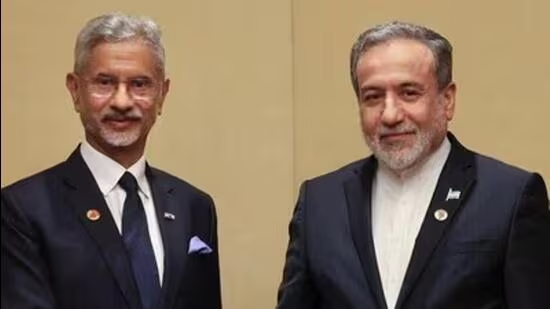
















Iranian foreign minister Seyed Abbas Araghchi has emphasised the role of Brics, currently led by India, in playing a constructive role in supporting security and stability in the region during a phone call with external affairs minister S Jaishankar — their fourth conversation since the start of the Iran-US conflict.
The two foreign ministers spoke on the phone on Thursday night, according to a social media post by Jaishankar. “Had another conversation with Iranian FM @araghchi yesterday night. Discussed bilateral matters as also BRICS related issues,” he said, without giving details.
A readout posted on the Iranian foreign ministry’s Telegram channel quoted Araghchi as emphasising the need for international and regional forums and organisations to condemn the military aggression against Iran.
“Referring to the importance of the role and position of Brics as a forum for developing multilateral cooperation, [Araghchi] considered it essential for this institution to play a constructive role at the current juncture to support stability and security in the region and the world,” said the readout issued in Persian.
Araghchi briefed Jaishankar on the latest situation “resulting from the aggressions and crimes committed by the US and [Israel] against Iran and its consequences for the stability and security of the region and the world. He emphasised the “firm will” of Iran’s government, people and armed forces to exercise the legitimate right to self-defence.
The readout quoted Jaishankar as expressing India’s readiness to develop bilateral and multilateral cooperation in regional and international forums and emphasising the importance of “finding a way to strengthen stability and sustainable security in the region as a collective need”.
Iran is one of the newest members of the Brics grouping, whose summit is expected to be held in India by the third quarter of this year. Brics has so far not issued any statement on the developments in West Asia.
Jaishankar and Araghchi had spoken earlier on February 28, March 5 (following the sinking of an Iranian warship by a US submarine near Sri Lanka) and March 10. Prime Minister Narendra Modi too spoke to Iranian President Masoud Pezeshkian on Thursday night for the first time since the start of the conflict and raised India’s priorities, including the safety and security of Indian nationals and the “unhindered transit of goods and energy”.
Iran is home to nearly 9,000 Indians, most of them students, while 10 million Indians live in West Asian countries, most of them concentrated in Saudi Arabia and the United Arab Emirates. India’s outreach to Iran’s leadership has also focused on measures to ensure the safe passage of India-flagged merchant shipping and foreign-flagged tankers and bulk carriers transporting oil, gas and other goods through the Strait of Hormuz, which has effectively been closed by the Islamic Revolutionary Guard Corps.
The safety of a large number of Indian seafarers, who make up almost 12% of the global seafaring workforce, is another priority for the government as recent attacks on merchant shipping have resulted in the deaths of three sailors, while another has been reported missing.



