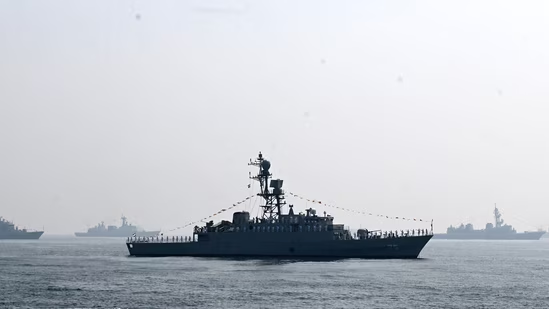






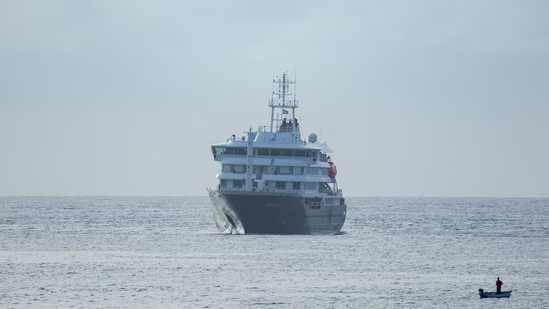




















The ripples of the US-Iran-Israel conflict in West Asia reached Indian Ocean waters on Wednesday after a US Navy submarine sank IRIS Dena, an Iranian warship, off the coast of Sri Lanka.
“An American submarine sunk an Iranian warship that thought it was safe in international waters. Instead, it was sunk by a torpedo, quiet death. The first sinking of an enemy ship by a torpedo since World War II,” said US Secretary of Defence Pete Hegseth.
At least 87 people were killed, and several remain missing at sea. 32 sailors were rescued by the Sri Lankan Navy, who responded to the distress call from the Iranian frigate, which had a total of 180 people on board.
Since the start of this war, the US Central Command has stated that Washington has sunk 17 Iranian vessels. IRIS Dena is the newest addition to this list.
As the US escalates its attacks on Iran, including on Iranian vessels in international waters, questions regarding the legality of US’ attacks have increased.
What does the Geneva Convention say?
The Second Geneva Convention, adopted in 1949, lays down the foundation for countries and their mandates for conflicts at sea.
The second part, which is also called the Convention for the Amelioration of the Condition of Wounded, Sick and Shipwrecked Members of Armed Forces at Sea, contains 63 articles, all of which have been ratified by the United States of America.
A key mandate under this part of the Geneva Convention is humane treatment and search for the shipwrecked, which the US Navy did not engage in.
As per Article 18 of the convention, parties to the conflict are required to take all possible measures to search for and collect the shipwrecked, wounded or sick.
“After each engagement, Parties to the conflict shall, without delay, take all possible measures to search for and collect the shipwrecked, wounded and sick, to protect them against pillage and ill-treatment, to ensure their adequate care, and to search for the dead and prevent their being despoiled,” reads the article.
However, The US submarine departed the area shortly after the attack.
Instead, the Sri Lankan Navy responded to the distress call from the Iranian ship. Sri Lankan officials also told the parliament that by the time personnel reached the site, the ship had sunk and was no longer visible on water.
What does US law say?
Furthermore, the US Naval Handbook also stated that any mistreatment of the shipwrecked such as killing or wounding, can be amounted to war crimes.
The Department of Defence’s Law of War Manual also suggests that attacking neutral vessels without cause, and failing to protect prisoners of war are prohibited acts and can be considered a war crime.
While there is no confirmation that the Iranian warship was armed, reports have claimed the frigate was armed with heavy guns, surface-to-air missiles, anti-ship missiles and torpedoes.
Speaking to Reuters, legal experts have stated that the attack on IRIS Dena was not unlawful. However, it could be argued that if the US is attacking Iran to eliminate an imminent threat, a warship far from Iran, and in Sri Lanka’s economic zone, would not be justified target unless it could be connected to threats raised by the current conflict.



