





















For the first time in the 113-year history of Test cricket, a series witnessed multiple matches finishing inside two days. The ongoing 2025/26 Ashes series in Australia saw the Perth opener conclude in just 847 balls after 19 wickets fell on the opening day, while the fourth Test at the MCG lasted only five balls longer, with all 20 wickets falling on Day 1.
The unusually short matches reportedly cost Cricket Australia an estimated $30 million in losses and triggered widespread criticism. However, despite the similar outcomes, the ICC handed out sharply contrasting pitch ratings. While the Perth surface was deemed “very good”, the MCG track was rated “unsatisfactory”.
What made Perth ‘very good’ and MCG ‘unsatisfactory’
The Perth Test marked just the 26th instance in 2,608 Tests where a match finished inside two days. Seven of those have come in the Ashes, though the last such occurrence in the rivalry dated back 104 years, to the opening Test at Nottingham in 1921. The Perth contest sparked sharp criticism of England’s aggressive ‘Bazball’ approach, while a contrasting outcome followed at the MCG, where England secured victory after chasing down 175 on the second day. It was the visitors’ first Test win on Australian soil since 2011.
Despite both matches ending within two days, the ICC delivered starkly different assessments. Perth received the highest rating under the ICC’s four-tier pitch and outfield evaluation system, while the MCG surface was deemed “unsatisfactory” and handed a demerit point. To understand the disparity, it is essential to unpack what the ratings actually signify.
Under the ICC framework, a “very good” pitch is defined as one that offers good carry, limited seam movement and consistent bounce early in the match, ensuring a balanced contest between bat and ball. By contrast, an “unsatisfactory” pitch is one that fails to provide an even contest, instead favouring the bowlers excessively by offering too many wicket-taking opportunities, whether through seam or spin.
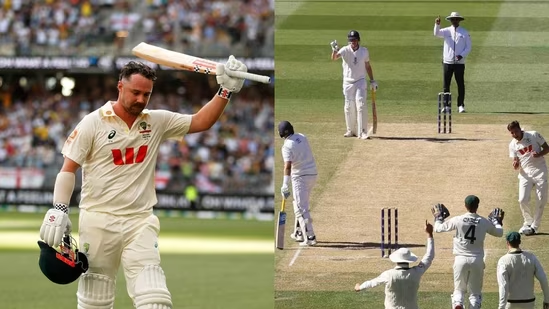
Former India captain Sunil Gavaskar may have been partially right in pointing out that Travis Head’s rapid century, off just 69 balls – his second-fastest Ashes hundred of all time, en route to a match-winning 123 helped Perth escape a poor rating. But despite 19 wickets falling on Day 1, the pitch had begun to flatten out towards the fag end of the day, and even more so on the second day, implying there was ample in store for both the batters and the bowlers. Australia pulled off a masterstroke in promoting Head up the order as the left-hander smashed 123 to help Australia chase down 205 in just 28.2 overs. Moreover, the match saw two other fifty-plus knocks, with Harry Brook (52) in the opening innings and Marnus Labuschagne (51*) on Day 2.
Barring Usman Khawaja, there weren’t any serious concerns raised over the Perth track, with the criticism largely directed towards England’s reckless batting across the two innings.
At MCG, the situation was worse. As 36 wickets fell across the six sessions of the Test match, the track showed no visible signs of easing up through the course of it. Batters scored 15.88 runs on average in the Boxing Day Test, with a control percentage of 69.61, the fourth-lowest for any WTC Test match. In Perth, the figures were 21.03 and 75.44, respectively.
Jeff Crowe from the Emirates ICC Elite Panel of Match Referees, explaining the rationale behind his assessment of the pitch, stated: “The MCG pitch was too much in favour of the bowlers. With 20 wickets falling on the first day, 16 on the second day, and no batter even reaching a half-century, the pitch was ‘Unsatisfactory’ as per the guidelines, and the venue gets one demerit point.” In fact, even Cricket data provider CricViz gave MCG an 8.9 difficulty rating out of 10, the highest for any Test match in Australia since 2006.
The Melbourne Cricket Club on Sunday accepted full responsibility for the pitch issues, with chief curator Matt Page explaining that extra grass was left on the drop-in surface to account for expected heat later in the Test. Page, who has been credited with reviving the MCG pitch after its low point in the 2017 Ashes draw, has overseen a clear shift towards seam-friendly conditions alongside Cricket Australia. The move, aimed at producing more engaging cricket, appears to have resonated with audiences, with Channel Seven reporting its highest-ever TV and streaming viewership for a Melbourne Test.
Page admitted he was particularly surprised by the amount of bounce the wicket generated after spending an entire day under covers ahead of the match following 25mm of rain. Notably, the surface carried less grass than several recent MCG Tests – 11mm for the 2021–22 Ashes, 12mm against New Zealand in 2019–20, and 8mm for the Pakistan Test in 2023–24 – all of which lasted three days or longer. Even last summer’s five-day Test against India was played on a pitch with just 7mm of grass. Despite those comparisons, the Melbourne surface offered more pace and bounce than expected.
By contrast, Perth curator Isaac McDonald left 9mm of grass on the opening Test pitch, yet the surface behaved far more predictably and did not produce the same exaggerated response



